
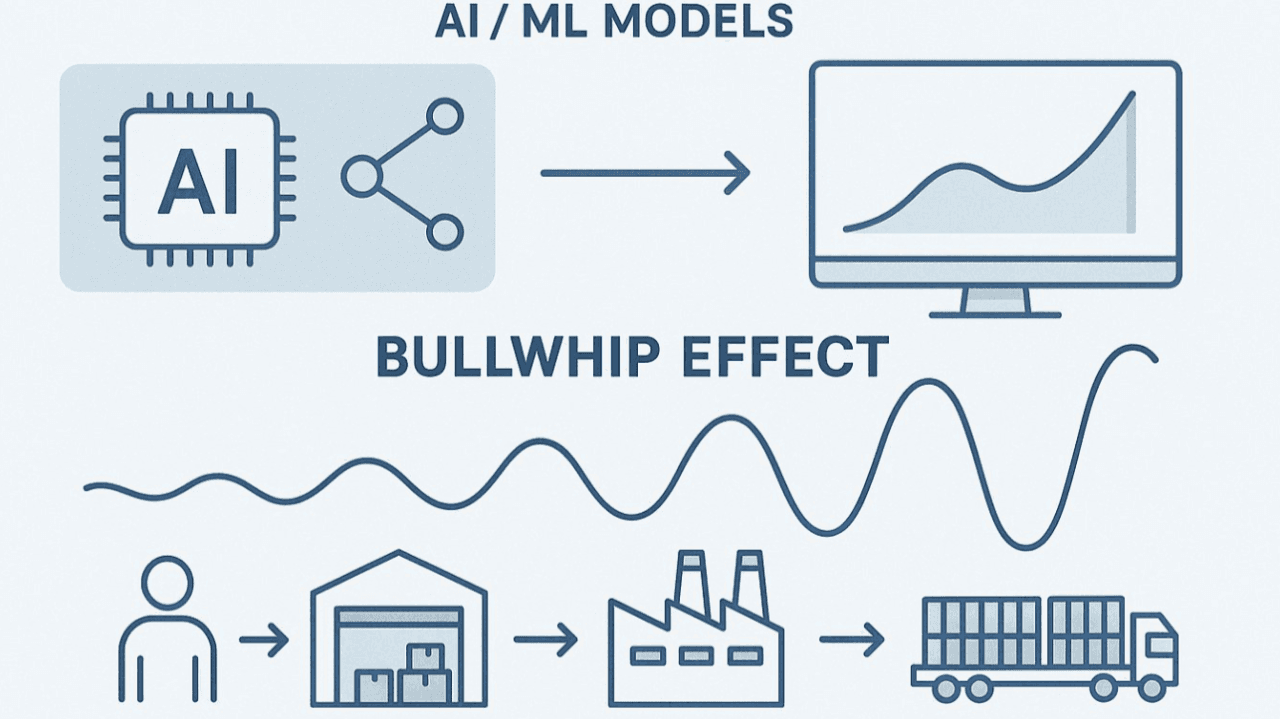
Signal to Noise Ratio: A critical risk when you leverage AI in Demand Planning

Kedar Kulkarni
Author
This article was originally published in the Supply Chain Alpha newsletter on LinkedIn. Read the original here.
Introduction
When leveraging AI in demand planning, one of the most critical risks that organizations face is the signal-to-noise ratio problem. This fundamental challenge can significantly undermine the accuracy and reliability of your forecasting models, leading to poor decision-making and operational inefficiencies.
Understanding Signal vs. Noise
In the context of demand planning, signal represents the meaningful patterns, trends, and relationships in your data that can be used to make accurate predictions. Noise, on the other hand, refers to random variations, outliers, and irrelevant information that obscure the true signal.
The Risk in AI-Driven Demand Planning
When implementing AI and machine learning models for demand forecasting, organizations often fall into the trap of:
- Including too many features without proper validation
- Overfitting models to historical noise rather than true patterns
- Failing to distinguish between correlation and causation
- Ignoring data quality issues that introduce noise
Mitigation Strategies
To effectively manage the signal-to-noise ratio in your AI demand planning initiatives:
1. Feature Engineering and Selection
- Carefully curate features that have proven predictive power
- Remove redundant or highly correlated features
- Validate feature importance through cross-validation
2. Model Regularization
- Use appropriate regularization techniques to prevent overfitting
- Implement cross-validation to ensure model generalizability
- Monitor model performance on out-of-sample data
3. Data Quality Management
- Establish robust data quality checks
- Identify and handle outliers appropriately
- Ensure data consistency across sources
4. Continuous Monitoring
- Track model performance metrics over time
- Monitor for drift in data patterns
- Regularly retrain models with fresh data
Conclusion
Successfully leveraging AI in demand planning requires a disciplined approach to managing the signal-to-noise ratio. By focusing on quality over quantity in your data and models, you can build more reliable and accurate forecasting capabilities.
What are your experiences with signal-to-noise challenges in demand planning? Share your thoughts and strategies in the comments below.
Found this helpful? Share it!