
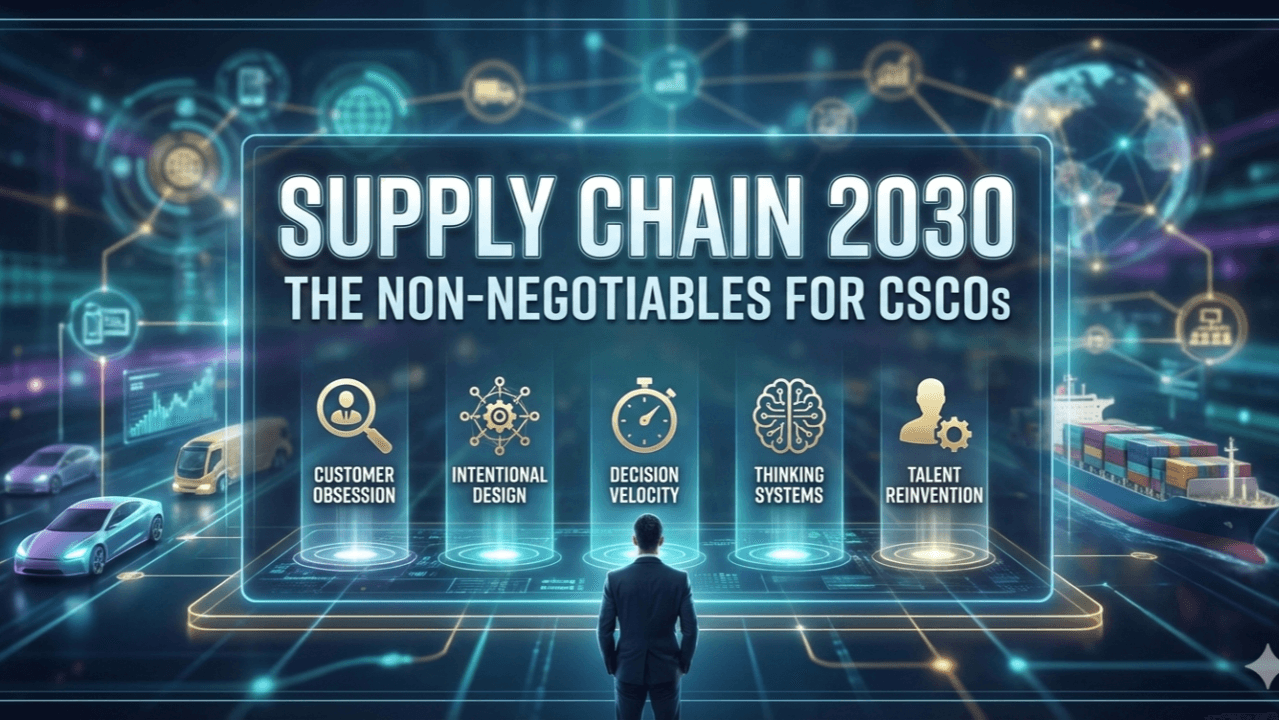
Supply Chain 2030 - The Non-Negotiables for CSCOs

Kedar Kulkarni
Author
This article was originally published in the Supply Chain Alpha newsletter on LinkedIn. Read the original here.
In 2004, early in my career as a supply chain planner, I remember reading confident projections about what "Supply Chain 2020" would look like.
Reality, of course, lagged badly.
Two decades later, what strikes me most isn't how much technology we've adopted. It's how similar the core problems still sound when executives talk about forecasting, inventory, service, cost, and risk.
Different tools. Same pain.
That gap—between ambition and outcomes—is part of why we started building at Strum AI. Not to add another layer of software, but to go after the root causes that keep these problems stubbornly intact.
As we kick off 2026, I want to take a longer view.
Let's mentally fast-forward to 2030—and then work backwards to craft a roadmap.
If you're a CSCO, COO, or if you lead Supply Chain, Operations, Procurement, Finance, or Technology, the real question isn't what tools you'll buy next year. It's this:
"What capabilities will be non-negotiable by 2030—the ones you simply won't survive without?"
Below are mine.
What I believe will be true by 2030
I'm anchoring this vision to a few beliefs that I think are inevitable—regardless of industry:

If you accept even half of these, the implications are profound.
The 2030 Supply Chain: Where to invest now
1. Obsess over the customer
- Extend your supply chain into customers and suppliers—eliminate systemic blind spots
- Model and Predict end-customer behavior; don't be fooled by the bullwhip of short-term order trends
- Own customer experience end-to-end: availability, delivery, cost, quality, returns
- Replace proxy metrics with direct signals as close to the customer interaction as possible; with rapid feedback loops into your operations
- Retire traditional, financially-focused sales forecasting. Treat demand data (Point-of-Sale, channel inventory, pricing, promotions, discounts, competitive data) as a shared enterprise asset across marketing, sales, finance and supply chain
- Reframe S&OP—not as aggregation and alignment bureaucracy, but as the Executive forum for strategic supply chain decisions
2. Design the supply chain intentionally
- Reject one-size-fits-all networks
- Rapidly model and simulate competing network design choices under uncertainty
- Differentiate inventory by form, function, and risk—not just SKU and location
- Make explicit trade-offs across agility, adaptability, and efficiency—and align engineering, sourcing, marketing and product teams to those choices
- Engage and align critical suppliers to ensure sourcing networks support the design choices made including joint investments in responsiveness, efficiency, resilience, sustainability etc.
3. Accelerate Supply Chain Decision-making
- Eliminate bureaucracy masquerading as alignment mechanisms
- Simplify, Optimize, then Automate to unleash speed
- Push reversible decisions down the organization; accelerate two-way door calls
- Retire systems that require humans to "prep and connect data"
- Invest in platforms that handle the "messy middle" between intent and decision
- Incentivize and Reward speed and quality of outcomes across teams and individuals
4. Build systems that can Think, Reason, Act and Learn alongside Humans
- Replace siloed, static applications with platforms that think, model and reason across the network and enable real-world decision-making
- Establish a canonical supply chain data model that evolves with the business. Data quality and maintenance becomes a crucial in-house capability—do not compromise
- Make the entire supply chain tech stack "configurable" by default—get rid of brittle, expensive customizations that do not adapt to change
- Let humans define objectives and make high judgement decisions; let systems orchestrate models, scenarios and economic payoffs under uncertainty and constraints
- Embed risk detection across planning and execution with configurable degrees of autonomy
- Expect 10-15X ROI on supply chain software spend—not incremental gains
5. Rebuild supply chain talent
- Future leaders must combine operations, economic and supply chain fundamentals with tech fluency to command and control AI-driven systems
- First-principles thinking will be a competitive advantage
- Training will be continuous, personalized, adaptive, and simulation-driven
- Talent pipelines will widen—systems thinkers won't all come from traditional supply chain paths
The Real Risk
2030 will arrive faster than we expect.
"The danger isn't over-investing. It's underestimating how unevenly and aggressively this change will hit."
Under-investing in technology, capabilities and talent will be the Real Risk.
Boards and CEOs won't always push for these capabilities early. That burden falls on the CSCO.
There is no Plan B here.
Use my framework to craft your vision and roadmap for Supply Chain 2030.
This is the 2030 Supply Chain Imperative.
Found this helpful? Share it!