
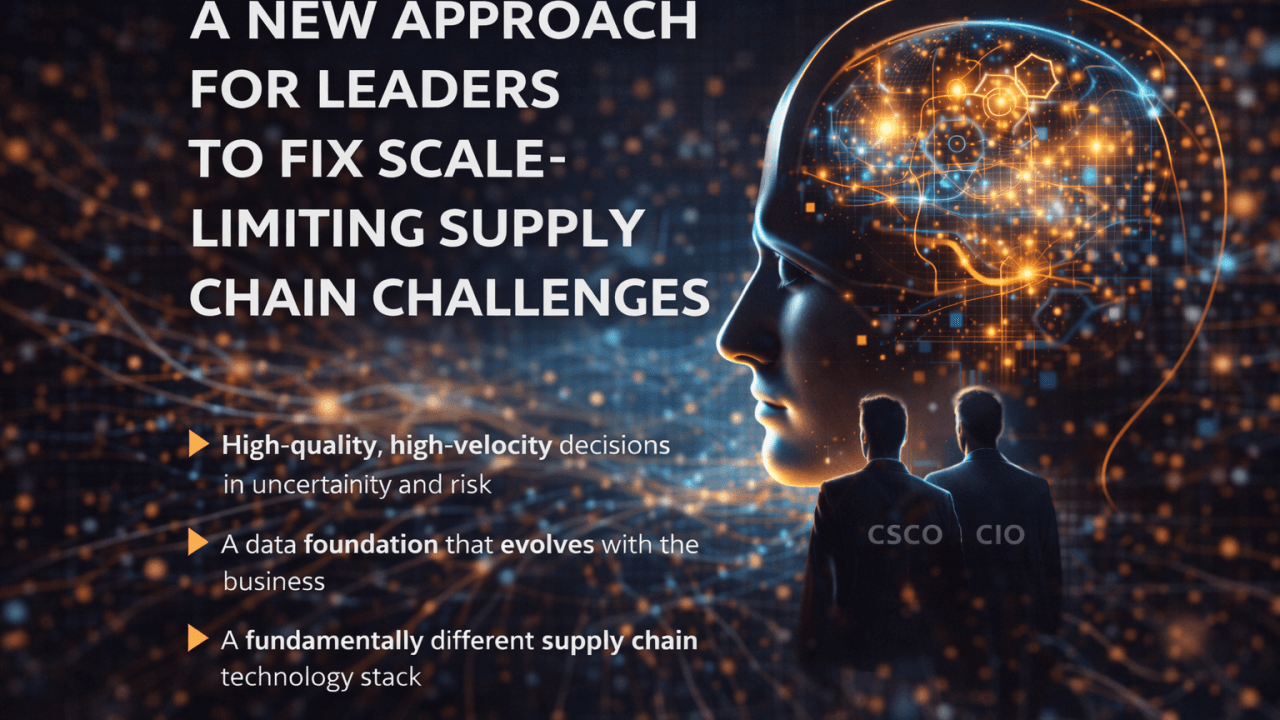
Unlocking Supply Chain Performance: Collapsing the Decision-loops in your Network

Kedar Kulkarni
Author
This article was originally published in the Supply Chain Alpha newsletter on LinkedIn. Read the original here.
Enterprise supply chains face a paradox: Despite two decades of technology investments, the core challenges around forecasting, inventory optimization, margin pressure, and service levels persist. In fact, the performance gap between industry leaders and average performers continues to widen.
Why?
I've spent the last several years deeply investigating this question, and I believe the answer lies not in what technology can do, but in how we've architected supply chain solutions.
Three Central Truths
Let me start with three fundamental theses that frame everything else:
1. High-quality, rapid decisions define supply chain performance
Your supply chain is only as good as the decisions you make—thousands of them, every day, across planning and execution. The organizations that consistently make better decisions faster will win.
2. Supply chain technology architecture is fundamentally transforming
We're at an inflection point. The modular, siloed approach that has dominated for 20 years is giving way to integrated platforms that reason across the entire network.
3. CSCOs and CIOs must rethink technology investments entirely
The old playbook—buying best-of-breed modules and integrating them—is broken. It's time for a new approach centered on outcomes, not features.
What Supply Chain Leaders Actually Need
When I talk to supply chain executives, they articulate three primary objectives:
1. Make high-quality decisions amid uncertainty and constraints
Supply chains operate in environments characterized by:
- Demand volatility and unpredictability
- Capacity constraints across the network
- Complex trade-offs between cost, service, and risk
- Time pressure and information asymmetry
Leaders need systems that help them navigate this complexity and make better decisions consistently.
2. Establish adaptive data foundations
Data requirements evolve as businesses grow, markets shift, and strategies change. Your data architecture must:
- Adapt to new products, channels, and geographies
- Integrate diverse data sources seamlessly
- Maintain quality and governance
- Support both operational and strategic analytics
3. Delegate analytical heavy lifting to technology
Your teams shouldn't spend their time wrangling data, building spreadsheets, or manually synthesizing insights across systems. They should focus on:
- Strategic judgment and decision-making
- Exception management and problem-solving
- Cross-functional collaboration
- Continuous improvement
Technology should handle the computational work.
The Architecture Problem
Here's where most supply chain technology falls short.
Current solutions operate in isolated modules:
- Demand Planning
- Inventory Optimization
- Replenishment
- Network Design
- Transportation Management
- Control Towers
- Analytics and Reporting
Each module solves a specific problem. But supply chain performance doesn't come from optimizing individual functions—it comes from making integrated decisions across the network.
This fragmented architecture forces human decision-makers to:
- Manually synthesize insights across systems
- Bridge gaps between planning and execution
- Reconcile conflicting recommendations
- Perform endless "swivel chair" integration
The result? Slow decisions, suboptimal outcomes, and frustrated teams.
The Monetization Dilemma
Why has the industry evolved this way?
The answer is uncomfortable: Vendor incentives.
Software companies have historically generated recurring revenue through modular expansions. Sell demand planning, then inventory optimization, then a control tower, then analytics... each with its own implementation, license, and maintenance fees.
This creates what I call "spaghetti architecture"—a tangled mess of point solutions held together by custom integrations and manual processes.
It benefits software providers, but delivers limited customer value.
What's Changing Now
The emergence of AI and modern data platforms enables a fundamentally different approach.
Instead of modules, think platforms that reason across the network.
Instead of features, think measurable business outcomes.
Instead of computational capacity, think decisions per unit time.
The next generation of supply chain technology will:
Unify planning and execution
Break down the artificial barrier between strategic planning and operational execution. Enable real-time plan updates based on execution realities.
Reason across domains
Understand the interdependencies between demand, supply, inventory, transportation, and cost. Make recommendations that optimize the system, not individual components.
Adapt to your business
Configure to your specific network, constraints, and objectives without expensive customization. Evolve as your business evolves.
Measure success by decisions
Track the quality and velocity of decisions as the fundamental unit of work. How many decisions did you make today? How good were they? How fast did you make them?
Call to Action for Executives
If you're a CSCO or CIO, here's what I urge you to do:
1. Demand configurable solutions that prioritize decision velocity
Stop accepting solutions that require months of implementation and customization. Look for platforms that:
- Deploy in weeks, not quarters
- Configure without coding
- Adapt to change continuously
- Measure decision quality and speed
2. Establish robust data model foundations
Invest in a canonical supply chain data model that:
- Evolves with your business
- Integrates diverse sources
- Maintains quality and governance
- Supports AI and analytics
Make data quality and maintenance a crucial in-house capability. Don't compromise here.
3. Invest in first-principles thinking
Build teams that understand supply chain fundamentals deeply and can reason from first principles. The future belongs to organizations that combine:
- Operations expertise
- Economic and financial acumen
- Technology fluency
- Systems thinking
4. Reject module proliferation
When vendors pitch you the next module, ask:
- How does this improve our decision velocity?
- What business outcomes will we achieve?
- How does this integrate with our existing stack?
- Can we prove the ROI within 90 days?
If the answers aren't compelling, walk away.
The Future Vision
Next-generation supply chain platforms will measure success through "high quality decisions per unit time" rather than computational capacity or feature lists.
They'll treat individual supply chain decisions as the fundamental work unit:
- Should we expedite this order?
- Where should we position inventory?
- Which supplier should we use?
- How should we respond to this disruption?
- What trade-offs should we make?
Every decision becomes visible, measurable, and improvable.
Conclusion
Enterprise supply chains have suffered for too long under fragmented architectures that prioritize vendor revenue over customer outcomes.
It's time for a new approach—one that:
- Collapses decision loops across the network
- Enables rapid, high-quality decisions at scale
- Adapts to your business without brittle customization
- Measures success by outcomes, not features
At Strum AI, we're building toward this vision. But regardless of who provides the technology, the principles remain the same.
The question for supply chain leaders is simple: Will you continue investing in modules that fragment decision-making, or will you demand platforms that collapse decision loops and unlock performance?
The answer will determine whether you lead the pack in 2030 or struggle to keep up.
Choose wisely.
Found this helpful? Share it!